Sector
Education

Education

Chester

Summer 2027

£67 Million

Dodd Group
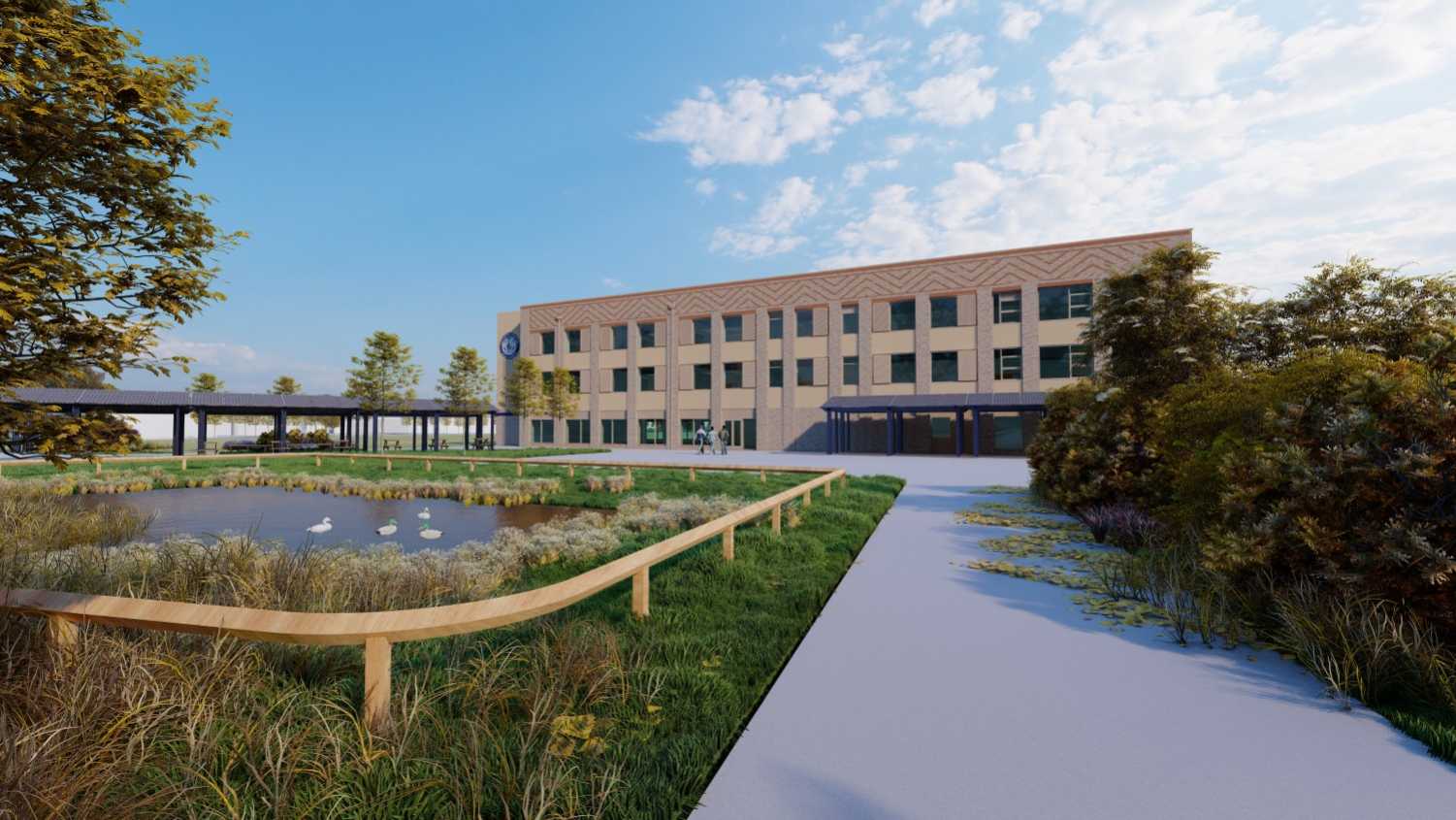
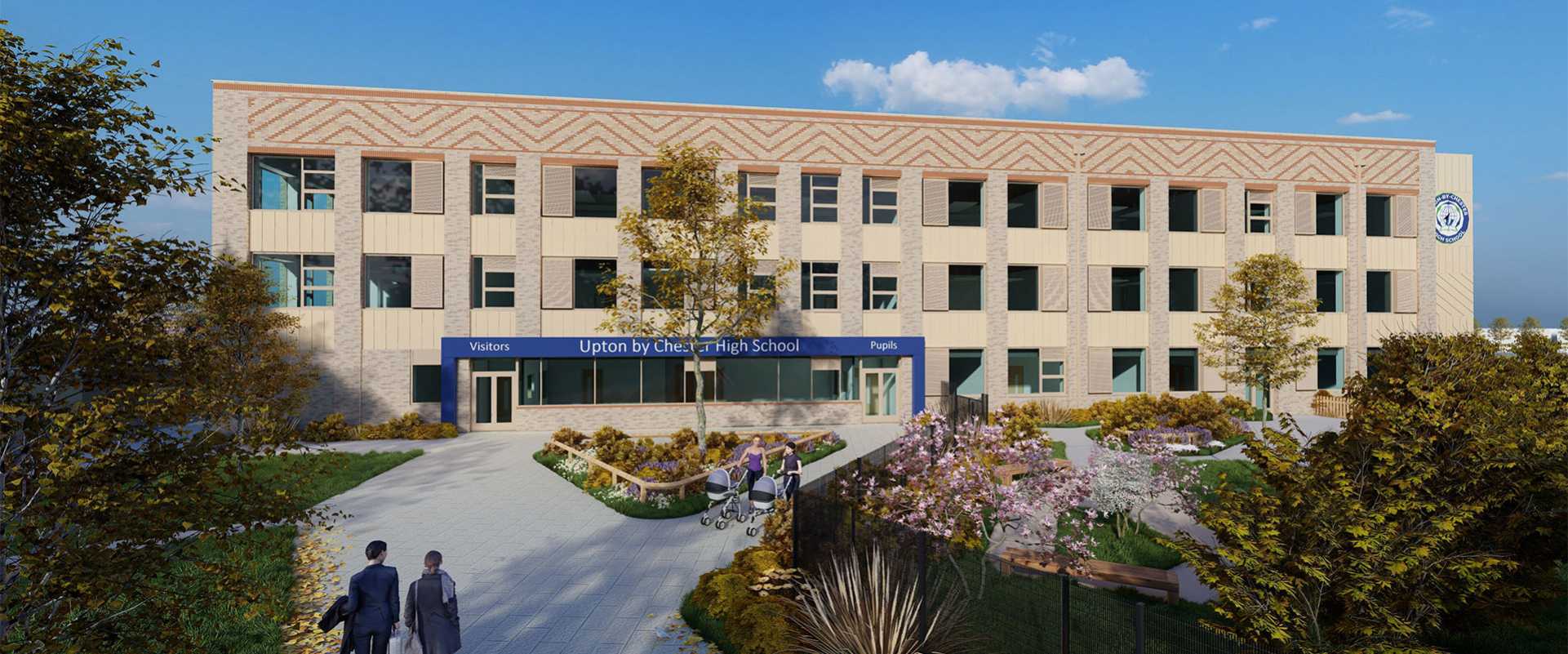
Upton-by-Chester High School is a high-quality, secondary school, designed to support students now and for future generations. As part of the Department for Education’s (DfE) School Rebuilding Programme, this modern, state of the art school redevelopment will provide spaces for 1,845 students and 175 staff in an inclusive, future-ready setting.
The design fosters connection and collaboration between the pupils, instilling a strong sense of community within the school. The C-shaped building creates a large sheltered open courtyard and brings classrooms, departments and shared learning spaces closer together, fostering connection and collaboration between pupils. This arrangement will improve circulation, encourage collaborative learning and strengthen everyday social connection.
Prioritising flexibility and adaptability, enabling the school to evolve as teaching practices and DfE requirements develop.
Arranged across three storeys, 40 classrooms, science laboratories, studios, a library, specialist music and design technology spaces and dedicated SEND provision, create an inclusive, inspiring learning environment for all learners.
The building services installation was designed to meet the requirements for current-day standards and specific client requirements to RIBA Stage 4 by Ridge and Partners LLP. Charles Andrews were appointed to undertake a validation of the design and develop to RIBA Stage 5.
Principal Contractor
Architect
Structural Engineer
MEP Sub-Contractor/Client
Charles Andrews Ltd (CAL) was appointed by Dodd Group to deliver the MEP design from RIBA Stage 4iii to Stage 5 and 6, building upon the Stage 4ii design developed by Ridge. Our scope included full technical development, validation, and coordination of all building services systems to ensure compliance, buildability, and resilience.
This included:
Space Heating is provided by Air Source Heat Pumps located in a remote external compound. These serve a primary plantroom within the new building Heating pipework is distributed from the internal plant room within the ground floor ceiling void to strategically located services risers within each half of the building. The pipework shall then rise up these risers and serve each half of each floor plate.
Ventilation is largely provided by individual room-based hybrid ventilation systems. These are supplemented by natural ventilation using a cross-flow stack ventilation principle with rising ventilation shafts within the circulation areas.
Dedicated service risers routed up the building shall be provided for central air handling unit systems which have larger ductwork to accommodate large air volumes.
Design suitable for construction stage.
With DfE Output Specifications, BB101, TM52, and CIBSE guidance.
Daily average CO2 concentrations below 1,000 ppm in teaching spaces.
Through distributed plant and zoned strategies.
And indoor air quality across all occupied areas.
Low‑carbon MEP solution suitable for long‑term educational use.